Notice of termination · Sale
Ending a tenancy to sell the property.
Sale is open to every landlord on older tenancies, and narrow on tenancies that began on or after 1 March 2026. Check the conditions below, then prepare the notice and the declaration with this ground already selected.
The short answer
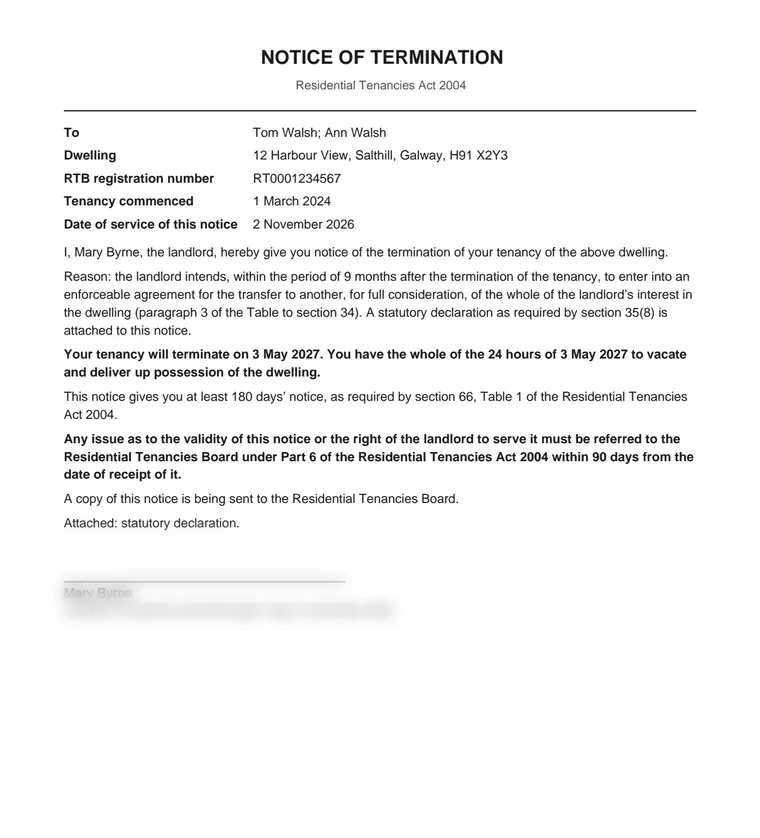
You can end a tenancy if you intend to sign an enforceable agreement to sell within 9 months of the tenancy ending. A sworn statutory declaration must go with the notice. For tenancies from 1 March 2026, only a small landlord can use this ground, and during the 6-year period only in a hardship case.
NoticeSure is a drafting tool, not a law firm, and does not give legal advice. You prepare your own document from your own answers. Not affiliated with the Residential Tenancies Board.
Who can end a tenancy to sell
It depends on when the tenancy began and, for the newest tenancies, on your size as a landlord. A small landlord is not a company and is the landlord under 3 tenancies or fewer s.35B(2). The count is taken on the day you serve the notice, not the day the tenancy began s.35(8)(c).
A large landlord on a tenancy from 1 March 2026 can still sell with the tenant in place: the tenancy continues with the buyer. For a tenancy that began before 11 June 2022, ending it without a ground at the end of the current cycle may also be open if you serve in time; check the cycle dates with the RTB before relying on it. More in small or large landlord.
| Tenancy began | Small landlord | More than 3 tenancies, or a company |
|---|---|---|
| Before 11 June 2022 | Yes | Yes |
| 11 June 2022 to 28 February 2026 | Yes | Yes |
| On or after 1 March 2026, ending during the 6-year period | Only in a hardship case s.35B(4) | No s.35B(2) |
| On or after 1 March 2026, ending at the end of the 6-year period | Yes s.35B(5) | No |
Selling during the 6-year period: the three hardship cases
For a tenancy that began on or after 1 March 2026, a small landlord can end it to sell before the 6-year period ends only in one of the three cases below, and only if not being able to sell would cause undue financial or other hardship s.35B(4). If none applies, wait: serve the notice before the period ends, with a notice period that expires on or after the end of the period s.35B(5). Take the sixth anniversary of the start, or a later day, as the termination date.
Your declaration names the case you rely on s.35(8)(c). The Act also says you must be able to show it to the satisfaction of the RTB, so keep the documents that prove it.
- You need the proceeds to buy a home to live in, for yourself or your spouse or civil partner.
- You need them to pay a debt or a Revenue liability of at least 15% of the expected sale price, legally due within 9 months after the termination date.
- You, or your spouse or civil partner, are in a specified insolvency situation: a personal insolvency practitioner appointed, bankruptcy or bankruptcy proceedings, or a composition or arrangement with creditors.
The statutory declaration that goes with the notice
The notice must include, or be accompanied by, a statutory declaration s.34(a)(ii); s.35(8). You sign it in person before a commissioner for oaths, a practising solicitor, a notary public or a peace commissioner. Your agent can sign the notice, but not the declaration. Have it sworn first, then serve both together: a declaration that arrives later does not accompany the notice, and the notice is invalid.
The declaration states:
- that you intend, within 9 months after the tenancy ends, to enter into an enforceable agreement to transfer your whole interest in the dwelling for full value;
- that if no such agreement is made in that time, and the tenancy was not validly ended on another ground, you must offer the tenancy back s.35(8)(aa);
- for a tenancy from 1 March 2026: that you are not a company and have 3 tenancies or fewer on the day of service, and either the hardship case you rely on or that the termination date falls on or after the end of the 6-year period s.35(8)(c);
- if you plan to sell 10 or more dwellings in the same development within 6 months: why the exception applies (a price more than 20% below the value with vacant possession, and undue hardship). Without the exception, sale is not available as a ground s.35A; s.35(8)(b).
Notice period, RTB copy and dispute time
The notice period depends on how long the tenancy has lasted on the day the tenant receives the notice s.66, Table 1: 152 days from 6 months to under a year, 180 days from 1 year to under 7, 196 days from 7 years to under 8, and 224 days from 8 years. A notice that ends the tenancy at the end of a 6-year period must also be served before that period ends.
A copy of the notice must reach the RTB within 7 days of service, or the notice is invalid s.62(1A). Upload it through the RTB Service Centre the same day you serve the tenant: see the RTB copy.
The notice tells the tenant they have 90 days from receiving it to refer any dispute about its validity to the RTB s.62(1)(g); s.80.
After the tenancy ends: the 9 months and the next rent
Count 9 months from the end of the notice period, or from the final decision if the tenant disputed the notice. If no enforceable agreement to sell exists by then, offer the former tenant the tenancy back in writing, with a reasonable time to accept of no more than 7 days s.35(8)(aa); s.35(6). An accepted offer continues the old tenancy. A listing with an estate agent, or a sale agreed “subject to contract”, is usually not yet enforceable: see offering the tenancy back.
If you end up letting the property again, sale is not one of the endings that lift the rent cap: the next rent stays capped unless the home was empty for 2 years, or 1 year for a protected structure s.19(5)(a). See market rent resets.
Mistakes that sink a sale notice
- Counting your tenancies on the day the tenancy began instead of the day you serve.
- Relying on a hardship case you cannot document, or on money worries that fit none of the three cases.
- Serving the notice first and the declaration later, or having the declaration signed by an agent.
- Missing the end of the 6-year period: once it has passed, the next chance to sell without a hardship case is the end of the following period.
- Sending the RTB copy late, or uploading a version that differs from the one the tenant received.
- Letting the 9 months pass without a signed agreement and without offering the tenancy back.
The full rules, with the law behind each one: Statutory declarations for a notice of termination.
Sources
- Residential Tenancies Act 2004, section 34 (revised)
- Residential Tenancies Act 2004, section 35 (revised)
- Residential Tenancies Act 2004, section 35A (revised)
- Residential Tenancies Act 2004, section 35B (revised)
- Residential Tenancies Act 2004, section 62 (revised)
- Residential Tenancies Act 2004, section 66 (revised)
- Residential Tenancies Act 2004, section 80 (revised)
- Residential Tenancies Act 2004, section 19 (revised)
- Residential Tenancies (Miscellaneous Provisions) Act 2026, section 14 (new section 35B)
- RTB guide 03: terminating a tenancy for intended sale
- RTB: how a landlord can end a tenancy
What you get for €24.90
- The notice of termination, built from your answers, with every statement section 62 requires
- The statement or statutory declaration (or both) your ground requires, ready to sign or swear; a refurbishment certificate must come from your construction professional
- A clean copy to sign and serve, with nothing else on it (no NoticeSure name anywhere)
- A sending sheet: how to serve it, the RTB copy (within 7 days, best the same day) and every date
- Your answers checked against the 2026 rules before you pay, with the section of the Act behind each point
- Email reminders if you ask for them, and a calendar file (.ics), for the dates that follow
- Download again for 12 months, on any device, with your purchase code
One payment, no subscription. You see the dates and whether your step is allowed before you pay. If a document cannot be produced because of a fault on our side, we fix it or refund you.
| Blank template | NoticeSure | Solicitor | |
|---|---|---|---|
| Cost | Free | €24.90, one payment | Professional fees |
| Tells you if your ground or step is allowed (2026 rules) | You check yourself | Checked against your answers, before you pay | Yes |
| Notice period and dates | You count yourself | Worked out, with safety days | Yes |
| Sending sheet with every deadline, and reminders | No | Yes | Depends |
| Copy ready to sign and serve | You fill it in | Filled in from your answers; you read and sign it | Yes |
| Advice on your own situation | No | No: a drafting tool | Yes |
Questions landlords ask
Do I need a buyer before I serve the notice?
No. You declare an intention to enter into an enforceable sale agreement within 9 months after the tenancy ends. If that does not happen, and the tenancy was not validly ended on another ground, you must offer the tenancy back to the former tenant (s.35(8)(aa)).
I have four rental properties. Can I still end a tenancy to sell?
For a tenancy that began before 1 March 2026, yes: the ground is open whatever the number of tenancies. For one that began on or after that date, no: with more than 3 tenancies on the day of service you are a large landlord (s.35B(2)). You can still sell with the tenant in place.
Who signs the declaration if the landlord is a company?
For a tenancy that began before 1 March 2026, the RTB’s guide says a person authorised under the company’s constitution, such as a director or the company secretary. For a tenancy that began on or after that date, a company cannot use the sale ground at all.
What if the tenancy has lasted less than six months?
Then no ground is needed. The notice states the category “other reasons”, the notice period is 90 days (no more than 120), and the tenant must receive it before the six months are up. No statutory declaration is required.
The full rules, with the law behind each one: Statutory declarations for a notice of termination.