Guide · Rent arrears
Rent arrears: the 28-day warning you must send before a notice
The short answer
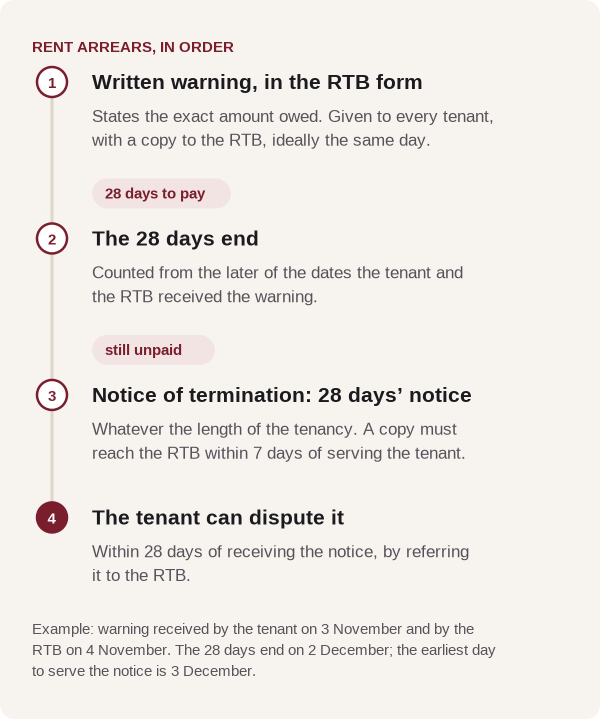
Before you can end a tenancy for unpaid rent, you must send a written warning stating the amount owed, to the tenant and to the RTB. The tenant then has 28 days to pay. Only after that can you serve a 28-day notice of termination.
The warning comes first
Unpaid rent is a ground for ending a tenancy, but only once a set procedure has been followed s.34, Table, ground 1A. The procedure starts with a written notification to the tenant stating that a specified amount of rent is due and has not been paid s.67(3)(a).
If you skip this step, or get it wrong, the notice of termination that follows is invalid, however much rent is owed. That is the most common way landlords lose an arrears case at the RTB.
What the warning must say
The Act says the warning must be in writing, in the form the RTB specifies, and must state the amount owed s.67(3)(a). The RTB’s own template asks for:
- the name of each tenant;
- the address of the dwelling and the tenancy’s RTB registration number;
- the current rent, and whether it is paid weekly, monthly or annually;
- the amount of arrears owed as of the date of the warning;
- the statement that failing to pay all of it within 28 days entitles you to terminate the tenancy;
- the date the warning is given to the tenant, and the date a copy is sent to the RTB;
- your signature and printed name.
Keep the figure exact and keep the records behind it: rent due, payments received, dates. An amount you cannot back up invites a dispute.
Send it to the RTB too
Sending the warning to the RTB is not a courtesy: it is part of the legal condition. The 28 days only start once both the tenant and the RTB have received it s.67(3)(b).
When the RTB receives the copy, it contacts the tenant with information on getting advice about budgeting and debt, and can help them with their consent s.67(3A)–(3B). You do not have to arrange any of that yourself.
The RTB recommends serving the tenant and the RTB on the same day. It removes any doubt about when the 28 days began.
Counting the 28 days
The tenant has 28 days to pay, counted from whichever is later: the date they received the warning, or the date the RTB received its copy s.67(3)(b).
Illustrative example. You email the warning to the tenant on 3 November and they receive it that day. The RTB’s copy arrives on 4 November. The 28 days run from 4 November and end on 2 December. If the full amount is still unpaid, the earliest day to serve the notice of termination is 3 December.
Keep proof of both receipts: the sent email with its date, or the postal receipt.
Then the notice of termination
If the arrears are not paid within the 28 days, you can serve a notice of termination giving 28 days’ notice, whatever the length of the tenancy s.67(2)(aa).
That notice must contain everything a notice of termination requires: your signature, the date of service, the reason, the termination date, and the statement that the tenant has 28 days to refer any dispute about its validity to the RTB. A copy must reach the RTB within 7 days of serving the tenant, or the notice is invalid.
Mistakes that sink it
- No copy to the RTB. The warning does not count, and neither does the notice that follows.
- A notice served too early. One day short of the 28 days is enough to invalidate it.
- A warning given to one tenant only, when several are named on the tenancy.
- An amount you cannot prove.
Since 14 September 2026, the RTB can treat a minor slip in the warning as not invalidating the process, if it did not prejudice the notice in a material respect s.64A. Treat that as a safety net, not a plan: get the warning right the first time.
One-page checklist
Before you serve the notice of termination
The warning and the notice, with every date worked out
NoticeSure fills in the RTB's warning form, tells you when the 28 days end, and prepares the notice of termination for the first day you can serve it.
Start the rent arrears pack