Guide · Statutory declarations
Statutory declarations for a notice of termination
The short answer
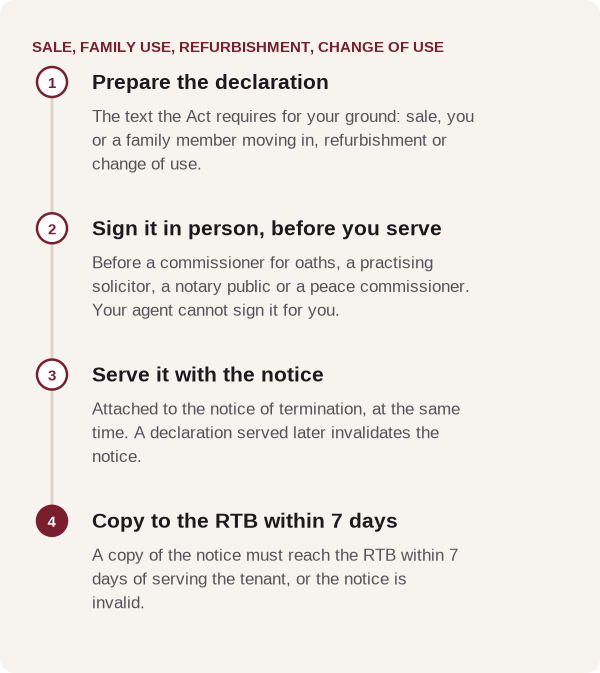
If you end a tenancy to sell, to move in yourself or a family member, to refurbish or to change its use, you must attach a statutory declaration to the notice when you serve it. You sign it in person before a commissioner for oaths, a practising solicitor, a notary public or a peace commissioner.
Which grounds need what
| Ground | What goes with the notice | Source |
|---|---|---|
| Rent arrears, breach | Nothing extra (the warning came before) | s.67 |
| Dwelling no longer suits the household | A statement | s.35(7) |
| Sale | A statutory declaration | s.35(8) |
| You or a family member will live there | A statutory declaration | s.34, Table, ground 4 |
| Substantial refurbishment | A statement, a statutory declaration for tenancies from 1 March 2026, and a certificate from a registered construction professional | s.35(9), s.35(10A), s.34(a)(iii) |
| Change of use | A statement, and a statutory declaration for tenancies from 1 March 2026 | s.35(10), s.35(10A) |
Served with the notice, not after
The notice must contain, or be accompanied by, the declaration or statement its ground requires s.34(a). A declaration served after the notice does not accompany it, so the notice does not meet that condition and is invalid. Have it sworn first, then serve both together, with the original going to the tenant.
Prepare a separate declaration for each notice, even when you serve several notices at once: each notice must be accompanied by its own.
Who can take the declaration
You sign the declaration personally: your agent can sign the notice for you, but not the declaration. You sign it in front of a commissioner for oaths, a practising solicitor, a notary public or a peace commissioner, who confirms who you are. If you sign abroad, extra formalities may apply.
Selling: what you declare
The declaration states s.35(8):
- that you intend, within 9 months after the tenancy ends, to enter into an enforceable agreement to sell your whole interest in the dwelling for full value;
- that if no such agreement is made within that time, and the tenancy was not otherwise validly ended, you must offer the tenancy back to the tenant.
For tenancies from 1 March 2026, it also states that you are not a company and have 3 tenancies or fewer on the day you serve, and either which hardship case applies (during the 6-year period) or that the tenancy ends on or after the end of the period s.35(8)(c).
If you are selling 10 or more dwellings in the same development within 6 months, sale is not available as a ground unless a narrow exception applies, and the declaration must say so s.35A.
You or a family member moving in: what you declare
The declaration states s.34, Table, ground 4:
- who will live in the dwelling, and their relationship to you;
- how long they are expected to live there;
- that if they leave within 12 months after the notice period ends, and the tenancy was not otherwise validly ended, you must offer the tenancy back.
For tenancies from 1 March 2026, it adds your small-landlord status and whether the tenancy ends before, on or after the end of the 6-year period.
Refurbishment and change of use
The statement describes the works or the new use, includes a copy of the planning permission (or, for works that need none, the contractor, dates and duration), and commits you to offer the tenancy back once the dwelling can be let again s.35(9)–(10).
For refurbishment, a registered construction professional must also certify that living there during the works would be a risk to health or safety for at least 3 weeks s.34(a)(iii).
The promise to offer the tenancy back
Each of these declarations or statements carries a promise. If it is triggered, you offer the tenancy back in writing, giving the former tenant a reasonable time to accept, no longer than 7 days s.35(6), (6A). If they accept, the new tenancy counts as a continuation of the old one s.35(6).
One-page checklist
On the day you serve
The declaration text, ready to be sworn
NoticeSure prepares the notice and the matching declaration, with every statement the Act requires for your ground. You take it to be sworn, then serve both together.
Prepare my notice and declaration