Guide · Small and large landlords
Small or large landlord? The 3-tenancy line in the 2026 rules
The short answer
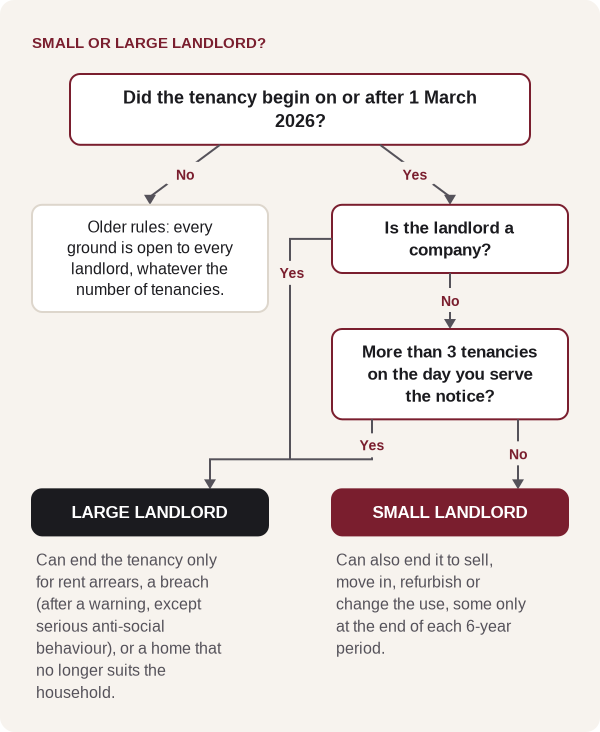
For tenancies that began on or after 1 March 2026, a landlord who is not a company and has 3 tenancies or fewer can still end a tenancy to sell, to move in or, at the end of a 6-year period, to refurbish or change its use. A larger landlord, or any company, can only end it for rent arrears, a breach, or because the dwelling no longer suits the household.
Who counts as a small landlord
You are a small landlord if both are true s.35B(2):
- you are not a company;
- you are the landlord under 3 tenancies or fewer.
A company is always treated as a large landlord, even if it lets a single dwelling.
The count is taken on the date you serve the notice of termination, not the date the tenancy began s.34, Table, ground 4(c); s.35(8)(c). If you sell a property or end another tenancy before serving, your status can change.
It only applies to tenancies from 1 March 2026
The distinction applies only to tenancies that began on or after 1 March 2026 s.35B(1). For tenancies that began before then, the grounds in the Act are open to every landlord, whatever the number of tenancies.
Those newer tenancies run in 6-year periods, counted from the start of the tenancy and then from each sixth anniversary. Some grounds can only be used at the end of one of these periods. See the 6-year periods explained.
What a small landlord can still do
| Ground | During the 6-year period | At the end of it |
|---|---|---|
| Rent arrears, breach | Yes | Yes |
| Dwelling no longer suits the household | Yes | Yes |
| You or a family member will live there | Yes | Yes |
| Sale | Only in a hardship case (below) | Yes |
| Substantial refurbishment | No | Yes |
| Change of use | No | Yes |
To end the tenancy at the end of a 6-year period, serve the notice before the period ends, and make sure the notice period expires on or after the end date s.35B(5).
Selling during the 6-year period
A small landlord can end the tenancy to sell during the 6-year period only if one of these applies s.35B(4):
- you need the proceeds to buy a home to live in, for yourself or your spouse or civil partner;
- you need them to pay a debt or a Revenue liability of at least 15% of the expected sale price, legally due within 9 months after the termination date;
- you, or your spouse or civil partner, are in a specified insolvency situation, such as bankruptcy or an arrangement with creditors.
In each case, not being able to sell must also cause you undue financial or other hardship. Your statutory declaration has to say which case applies s.35(8)(c).
Family members: a shorter list during the period
The family members who can move in normally include a spouse or civil partner, children, stepchildren, foster children, grandchildren, parents, grandparents, step-parents, parents-in-law, brothers, sisters, nephews, nieces and adopted persons s.35(4)(a).
If the termination date falls during a 6-year period, grandchildren, grandparents, brothers, sisters, nephews and nieces are removed from that list s.35(4)(b).
What a large landlord can do
For tenancies from 1 March 2026, a large landlord or a company can end a tenancy only for s.35B(2):
- rent arrears, after the 28-day warning;
- a breach of the tenant’s obligations, after a written warning (none is needed for serious anti-social behaviour);
- the dwelling no longer suiting the household’s needs.
Selling with the tenant in place remains possible: the tenancy simply continues with the buyer.
Check which grounds are open to you
Tell NoticeSure when the tenancy began and how many tenancies you have. It shows the grounds you can use and the earliest date the tenancy can end.
Check my situation, free