Notice of termination · Own or family use
Ending a tenancy so you or a family member can live there.
Of the grounds based on the landlord’s own plans, this is the only one a small landlord can use at any point of a 6-year period, with no hardship test. Who counts as family, and what you declare, depend on when the tenancy began.
The short answer
You can end a tenancy if you, or a family member listed in the Act, need the dwelling to live in. A sworn statutory declaration naming the occupant, the relationship and the expected duration goes with the notice. A company cannot use this ground, and for tenancies from 1 March 2026 neither can a landlord with more than 3 tenancies.
NoticeSure is a drafting tool, not a law firm, and does not give legal advice. You prepare your own document from your own answers. Not affiliated with the Residential Tenancies Board.
Who can use this ground
The landlord, or a member of the landlord’s family, must require the dwelling to live in s.34, Table, para. 4. A company landlord cannot use it, whatever the date the tenancy began.
Unlike sale, refurbishment and change of use, a small landlord on a tenancy from 1 March 2026 does not have to wait for the end of the 6-year period s.35B(3). What changes during the period is who counts as family (below). Your number of tenancies is counted on the day you serve s.34, Table, para. 4(c).
| Tenancy began | Individual landlord, 3 tenancies or fewer | Individual landlord, more than 3 tenancies |
|---|---|---|
| Before 1 March 2026 (including before 11 June 2022) | Yes, at any time | Yes, at any time |
| On or after 1 March 2026 | Yes, during or at the end of the 6-year period | No s.35B(2) |
Who counts as a family member
The Act gives a closed list s.35(4)(a). For a tenancy that began on or after 1 March 2026, six relationships drop out when the termination date falls before the end of the 6-year period s.35(4)(b).
| Relationship to you | Tenancy before 1 March 2026, or ending at the end of a 6-year period | Tenancy from 1 March 2026, ending during the 6-year period |
|---|---|---|
| Spouse or civil partner | Yes | Yes |
| Child, stepchild, foster child, or a person you adopted | Yes | Yes |
| Parent, step-parent, parent-in-law | Yes | Yes |
| Grandchild, grandparent | Yes | No |
| Brother, sister, nephew, niece | Yes | No |
| Anyone else, such as an aunt, uncle or cousin | No | No |
The declaration that goes with the notice
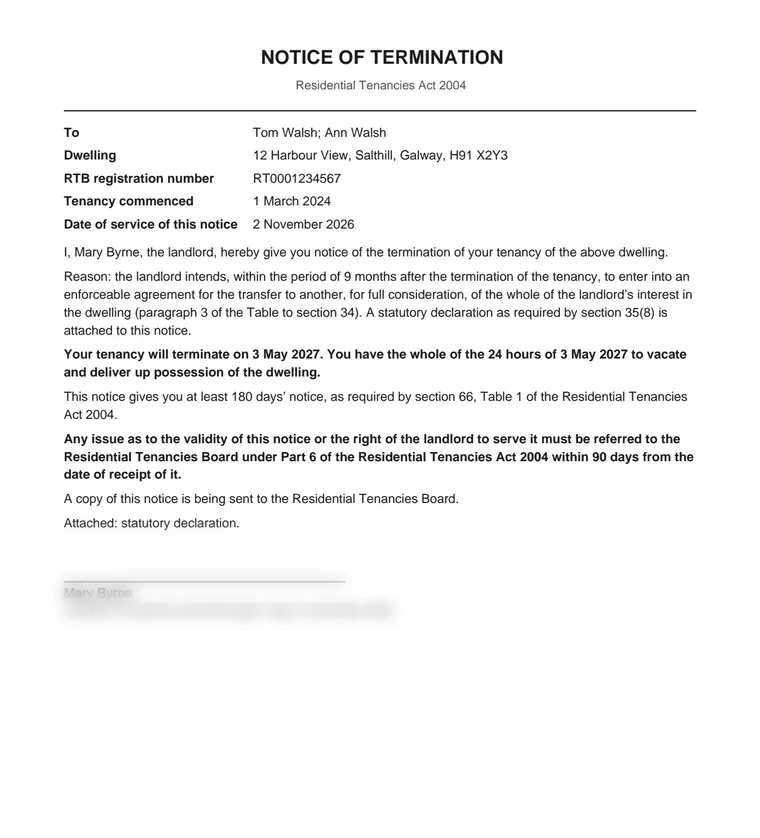
The notice must come with a statutory declaration s.34(a)(ii); s.34, Table, para. 4. You sign it yourself, in person, before a commissioner for oaths, a practising solicitor, a notary public or a peace commissioner. Nobody can sign it for you, not even your agent. Have it sworn before the date of service, and serve it with the notice, never after.
It states:
- who will live in the dwelling and, if it is not you, their relationship to you;
- how long they are expected to live there;
- that if they leave within 12 months of the end of the notice period, and the tenancy was not validly ended on another ground, you must offer the tenancy back s.34, Table, para. 4(b);
- for a tenancy from 1 March 2026: that you are not a company and have 3 tenancies or fewer on the day of service, and whether the termination date falls before, on or after the end of the 6-year period s.34, Table, para. 4(c).
Notice period and serving
The notice period follows the length of the tenancy on the day the tenant receives the notice s.66, Table 1. NoticeSure adds a few safety days for the delivery method, so a late delivery never leaves the notice short.
Serve the notice and the declaration together, then send the RTB its copy of the notice: the Act allows 7 days, and a late copy makes the notice invalid s.62(1A). The tenant has 90 days from receipt to dispute the notice at the RTB s.80.
| Length of the tenancy on the day of service | Notice period |
|---|---|
| 6 months to under 1 year | 152 days |
| 1 year to under 7 years | 180 days |
| 7 years to under 8 years | 196 days |
| 8 years or more | 224 days |
If plans change: the 12 months and the rent
If the person who moved in leaves within 12 months of the end of the notice period, or of the final decision on a dispute, you must offer the former tenant the tenancy back in writing, with no more than 7 days to accept s.34, Table, para. 4(b); s.35(6). If they accept, their time counts as one continuous tenancy. See offering the tenancy back.
Own or family use does not lift the rent cap for a later letting s.19(5)(a)(iii). If the property is let again, the cap runs from the last rent set, unless the home stayed empty for 2 years.
Common mistakes
- Naming a brother, niece or grandchild on a tenancy from 1 March 2026 when the termination date falls inside the 6-year period.
- Leaving out the expected duration of the occupation: the Act requires it.
- Using the ground through a company, or with more than 3 tenancies on a tenancy from 1 March 2026.
- Having the declaration signed by an agent, or serving it after the notice.
- Letting the property again within 12 months of the occupant leaving without first offering it to the former tenant.
- Giving a reason you know to be untrue: that is improper conduct the RTB can sanction, and a false statutory declaration is a criminal offence.
The full rules, with the law behind each one: Small or large landlord? The 3-tenancy line in the 2026 rules.
Sources
- Residential Tenancies Act 2004, section 34 (revised)
- Residential Tenancies Act 2004, section 35 (revised)
- Residential Tenancies Act 2004, section 35B (revised)
- Residential Tenancies Act 2004, section 62 (revised)
- Residential Tenancies Act 2004, section 66 (revised)
- Residential Tenancies Act 2004, section 80 (revised)
- Residential Tenancies Act 2004, section 19 (revised)
- RTB guide 04: dwelling needed for landlord or family occupation
- RTB: how a landlord can end a tenancy
What you get for €24.90
- The notice of termination, built from your answers, with every statement section 62 requires
- The statement or statutory declaration (or both) your ground requires, ready to sign or swear; a refurbishment certificate must come from your construction professional
- A clean copy to sign and serve, with nothing else on it (no NoticeSure name anywhere)
- A sending sheet: how to serve it, the RTB copy (within 7 days, best the same day) and every date
- Your answers checked against the 2026 rules before you pay, with the section of the Act behind each point
- Email reminders if you ask for them, and a calendar file (.ics), for the dates that follow
- Download again for 12 months, on any device, with your purchase code
One payment, no subscription. You see the dates and whether your step is allowed before you pay. If a document cannot be produced because of a fault on our side, we fix it or refund you.
| Blank template | NoticeSure | Solicitor | |
|---|---|---|---|
| Cost | Free | €24.90, one payment | Professional fees |
| Tells you if your ground or step is allowed (2026 rules) | You check yourself | Checked against your answers, before you pay | Yes |
| Notice period and dates | You count yourself | Worked out, with safety days | Yes |
| Sending sheet with every deadline, and reminders | No | Yes | Depends |
| Copy ready to sign and serve | You fill it in | Filled in from your answers; you read and sign it | Yes |
| Advice on your own situation | No | No: a drafting tool | Yes |
Questions landlords ask
Can my brother or sister move in?
Yes for a tenancy that began before 1 March 2026. For one that began on or after that date, only if the termination date falls at or after the end of the 6-year period: during it, brothers, sisters, nephews, nieces, grandchildren and grandparents do not count (s.35(4)(b)).
I have 3 properties and a tenancy that began in 2026. Do I have to wait 6 years?
No. A small landlord can use this ground during the 6-year period. Only the list of family members is shorter until the period ends.
How long does the family member have to stay?
The Act sets no minimum, but the declaration must state the expected duration, and if the occupant leaves within 12 months of the end of the notice period you must offer the tenancy back to the former tenant (s.34, Table, para. 4(b)).
Can a company end a tenancy so that someone can move in?
No. This ground is for an individual landlord who needs the dwelling for themselves or a listed family member. A company cannot use it, whatever the date the tenancy began.
The full rules, with the law behind each one: Statutory declarations for a notice of termination.